

A practical guide to titles, licensing, court representation, and choosing legal help
Legal titles can be confusing because people, courts, law firms, and television programs often use several words for the same professional. You may hear attorney, lawyer, counsel, counselor, advocate, or attorney-at-law even when everyone is referring to a person who is licensed to provide legal services.
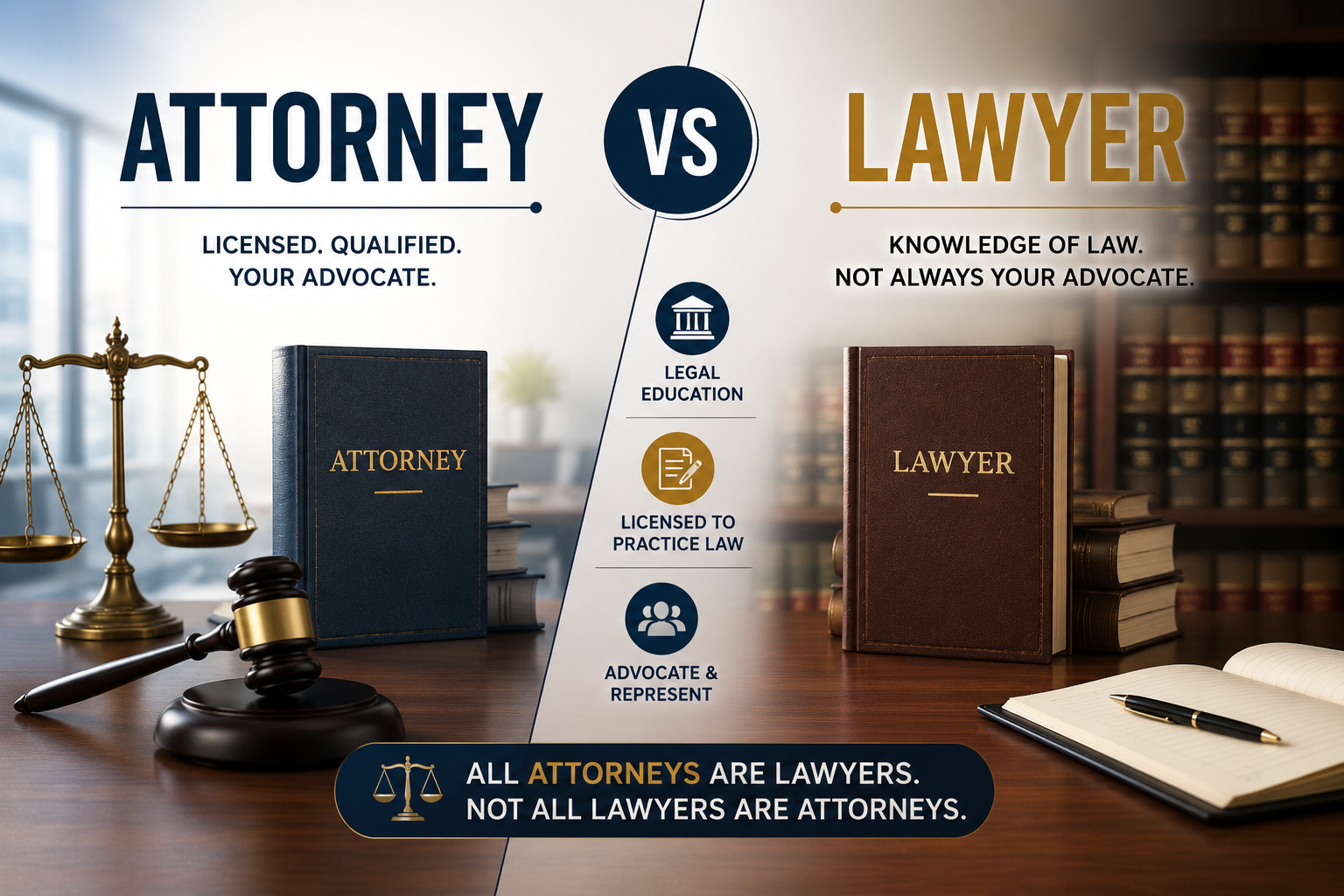
The simplest answer to attorney vs lawyer is that the terms are generally interchangeable in modern American usage. A popular distinction says that a lawyer has legal education while an attorney is licensed to practice, but consumers should not assume that every person with a law degree can give legal advice or represent clients. The practical question is whether the professional is currently authorized to practice in the relevant jurisdiction and is qualified for the type of matter involved.
The American Bar Association describes a lawyer as a licensed professional who advises and represents others in legal matters, and it notes that lawyer, attorney, counsel, and counselor are commonly used for the same role. The ABA explanation of what a lawyer does supports the everyday view that there is usually no meaningful difference between the two titles when discussing licensed US legal professionals.
| Key Takeaways
· In everyday US usage, “attorney” and “lawyer” usually mean the same thing. · A law degree alone does not automatically authorize someone to practice law or represent clients. · Licensing is controlled by individual states and other jurisdictions, not by one national bar license. · A licensed attorney may still need separate admission to appear in a particular court or another state. · Consumers should verify license status, disciplinary history, experience, fees, and communication practices before hiring. |
Attorney vs Lawyer at a Glance
| Term | Typical US meaning | Can represent clients? | Important qualification |
| Lawyer | Common name for a licensed legal professional | Usually yes, if authorized in the jurisdiction | Check current license and court admission |
| Attorney | Usually the same as lawyer or attorney-at-law | Usually yes, if authorized in the jurisdiction | May also have non-lawyer meanings in phrases such as attorney-in-fact |
| Law school graduate | A person who earned a JD or another legal degree | Not automatically | Must satisfy licensing requirements before practicing |
| Counsel or counselor | Another professional title for a lawyer | Usually yes | May describe an in-house, outside, or advisory role |
| Attorney-in-fact | An agent named under a power of attorney | No, not merely because of that appointment | The title does not mean the person is a licensed lawyer |
Why People Think the Terms Are Different
Many explanations draw a neat line between education and licensing. Under that explanation, a lawyer is someone who studied law, while an attorney is a lawyer admitted to a bar and able to act for clients. This distinction is easy to understand, so it appears frequently in online articles and casual discussions.
The Justia question-and-answer page supplied as the reference presents this common distinction and also notes that the terms are often interchangeable. The attorney answers on Justia emphasize licensing and the authority to act for another person, which is the part that matters most when someone needs representation.
However, the distinction is not a universal legal rule that every state applies to ordinary conversation. Bar associations, courts, statutes, and law firms routinely use attorney and lawyer as synonyms. Calling an unlicensed law graduate a lawyer may also create confusion if the title suggests that the person can provide services that legally require admission to practice.
What Makes Someone Authorized to Practice Law?
Admission rules vary by jurisdiction, but the process generally involves legal education, a bar examination or another approved admission route, a character-and-fitness review, and formal admission by the jurisdiction. Some states use the Uniform Bar Examination, while others maintain additional or different requirements.
There is no single nationwide license that automatically permits unlimited practice in every state. A person admitted in New York, for example, is not automatically authorized to open a general law practice in Texas. Lawyers who work across state lines must follow the licensing and professional-conduct rules that apply to each situation.
Court admission can create another layer. A lawyer licensed by a state may need separate admission to practice in a federal district court, federal appellate court, bankruptcy court, or specialized tribunal. In some cases, an out-of-state lawyer may request temporary admission known as pro hac vice while working with locally admitted counsel.
Licensing Status Matters More Than the Title
| Question to verify | Why it matters | Where to check |
| Is the license active? | An inactive, suspended, or disbarred person generally cannot provide the same services as an active lawyer. | The official state bar or attorney-regulation website |
| Is the lawyer admitted where the matter is pending? | A valid license in one jurisdiction may not authorize practice in another. | State bar, court roster, or clerk information |
| Is there public disciplinary history? | Discipline may reveal ethical, trust-account, communication, or competence problems. | Official attorney profile maintained by the regulator |
| Does the person handle this practice area? | Licensure alone does not establish experience in a specific field. | Consultation, written biography, court history, and references |
| Is the fee agreement clear? | The client should understand scope, billing, expenses, and termination terms. | Written engagement agreement |
Can a Law School Graduate Give Legal Advice?
A person may earn a Juris Doctor degree and still be unlicensed. This can happen because the graduate has not taken the bar exam, did not pass it, has not completed admission requirements, chose a non-practicing career, or allowed a license to become inactive. The degree demonstrates education, but it does not by itself provide unrestricted authority to practice law.
Unlicensed graduates may work in compliance, contracts, policy, legal operations, consulting, education, or business roles. They may perform valuable law-related work under appropriate supervision, but they must avoid activities that a jurisdiction reserves for licensed lawyers. Unauthorized practice rules differ, so the exact boundary depends on local law and the nature of the service.
Can Every Attorney Appear in Court?
Not necessarily. Many licensed attorneys spend little or no time in court. Transactional lawyers may focus on contracts, business deals, tax planning, real estate, estate planning, intellectual property, or regulatory work. They are still attorneys even if litigation is not part of their daily practice.
A courtroom appearance also requires appropriate jurisdictional and court admission. An attorney who is highly experienced in estate planning may not be the best choice for a felony trial, just as an experienced criminal defense lawyer may not be the right professional for a complex corporate merger. The title identifies professional status, not mastery of every legal field.
Other Legal Titles You May Encounter
| Title | What it commonly means | Consumer note |
| Esquire or Esq. | A courtesy title often used after a lawyer’s name | It is not a substitute for checking an active license |
| Counsel | A lawyer advising or representing a client or organization | May refer to in-house counsel, outside counsel, or of counsel |
| Public defender | A government-funded defense attorney for eligible criminal defendants | Availability and eligibility depend on the case and jurisdiction |
| Prosecutor | A government attorney who brings criminal cases | Titles include district attorney, state’s attorney, county attorney, or US attorney |
| Solicitor or barrister | Distinct professional titles in some other countries | US terminology and licensing structure are different |
| Paralegal | A trained legal support professional working under lawyer supervision | A paralegal is not independently licensed to practice law |
Attorney-in-Fact Does Not Mean Attorney-at-Law
The word attorney can also appear outside the professional licensing context. An attorney-in-fact is a person authorized through a power of attorney to act for someone else in specified financial, property, healthcare, or personal matters. The agent may be a family member, friend, or professional and does not become a licensed lawyer simply because the document uses the word attorney.
An attorney-at-law, by contrast, is a licensed legal professional. This difference matters when reviewing powers of attorney, estate-planning documents, banking forms, or healthcare directives. The agent can exercise the authority granted by the document but cannot offer legal services to the public merely by holding that role.
Which Term Should You Use?
For most US writing and conversation, either lawyer or attorney is acceptable. Lawyer is often the more natural everyday word. Attorney may sound more formal and commonly appears in court documents, firm names, government titles, and phrases such as attorney-client privilege.
A professional may prefer a particular title, but consumers do not need to worry about choosing the wrong synonym. It is more important to use the person’s correct name, confirm the representation, understand the scope of work, and communicate through agreed channels.
How to Choose the Right Legal Professional
The best legal professional is not determined by whether a website says attorney or lawyer. Start with jurisdiction and practice area. A local professional who regularly handles the relevant type of matter may understand procedures, deadlines, judges, agencies, opposing counsel, and practical settlement patterns that a generalist does not encounter as often.
Before scheduling consultations, review a structured guide on how to choose the right lawyer for your case. Compare experience, availability, fee structure, likely strategy, possible outcomes, and who will perform the day-to-day work. Large firms may assign associates or paralegals, while solo attorneys may handle more tasks personally.
During the consultation, describe the facts honestly and provide important documents. Ask whether the professional has handled similar matters, what deadlines may apply, what the engagement includes, how billing works, and how often updates are provided. No ethical lawyer should guarantee a result that depends on a judge, jury, opposing party, agency, or uncertain evidence.
A prepared list of questions to ask an attorney before hiring can make consultations more useful and help you compare answers consistently. Written notes are especially helpful when the matter is stressful or when several professionals offer different strategies.
Red Flags When Hiring Legal Help
- The person will not provide a bar number or avoids questions about licensing.
- The official regulator shows an inactive, suspended, or otherwise restricted status.
- The person guarantees victory or promises a specific settlement before reviewing the evidence.
- The fee arrangement is unclear, entirely verbal, or inconsistent with the written agreement.
- The professional pressures you to sign immediately without allowing reasonable review.
- Communication is repeatedly ignored before the representation has even begun.
- The person asks you to hide facts, destroy records, mislead a court, or contact a represented opposing party improperly.
Do You Always Need an Attorney?
Individuals are sometimes permitted to represent themselves, a status known as pro se representation. Small claims, uncontested filings, administrative forms, and simple matters may be manageable without full representation, especially when courts provide self-help resources. However, self-representation does not excuse compliance with deadlines, evidence rules, procedure, or substantive law.
Professional advice becomes especially important when liberty, immigration status, professional licensing, child custody, substantial property, serious injury, business control, or large financial exposure is at stake. Limited-scope representation may be an option when full-service representation is unaffordable. A lawyer might review documents, coach the client, negotiate one issue, or appear for a specific hearing while the client handles other tasks.
Frequently Asked Questions
Is an attorney higher than a lawyer?
No. In ordinary US usage, attorney is not a higher rank than lawyer. The words usually describe the same licensed profession. Seniority is more often shown through job titles such as partner, associate, managing attorney, general counsel, or chief legal officer.
Can someone be a lawyer without passing the bar?
Casual explanations sometimes use lawyer for any law school graduate, but a degree alone does not authorize legal practice. For consumer safety, confirm that anyone offering legal services is licensed and authorized in the relevant jurisdiction.
What does JD mean after a person’s name?
JD means Juris Doctor, the standard professional law degree in the United States. It reflects education, not necessarily current bar admission. Esq. is commonly associated with practicing lawyers, but official license records remain the reliable verification source.
Can an attorney practice in every state?
Usually not automatically. Lawyers are admitted by individual jurisdictions. Reciprocity, admission on motion, temporary practice rules, federal court admission, and pro hac vice procedures may allow work outside the original state, but the lawyer must follow the applicable rules.
Are paralegals lawyers?
No. Paralegals perform important legal support work, often including research, document preparation, case organization, and client coordination under lawyer supervision. They generally cannot independently provide legal advice, set fees, accept cases, or represent clients in court unless a specific law authorizes a limited role.
Final Verdict
The attorney-versus-lawyer debate is less important than many online explanations suggest. In modern US practice, the terms normally refer to the same licensed legal professional. The useful distinction is between someone who has legal education and someone who is currently authorized to practice, represent clients, and appear in the relevant jurisdiction or court.
When hiring legal help, focus on verifiable credentials, relevant experience, ethical history, communication, and a clear written fee agreement. A title on a business card or website is only the starting point. Official licensing records and a careful consultation provide far more meaningful information.
| Legal Disclaimer
· This article provides general educational information about US legal terminology and does not create an attorney-client relationship. · Licensing, unauthorized-practice, court-admission, and representation rules vary by jurisdiction. · Consult an attorney authorized in the relevant jurisdiction for advice about a specific legal matter. |
