

A plain-English guide to Learning Resources v. Trump, the major questions doctrine, and the limits of presidential tariff power
| Case fact | Details |
| Case | Learning Resources, Inc. v. Trump, consolidated with Trump v. V.O.S. Selections, Inc. |
| Dockets | Nos. 24-1287 and 25-250 |
| Decision date | February 20, 2026 |
| Vote on result | 6-3 |
| Holding | IEEPA does not authorize the President to impose tariffs |
| Gorsuch role | Joined the principal opinion in full and wrote a separate concurrence |
| Central idea | Extraordinary executive power requires clear statutory authorization |
| Important limit | The ruling did not invalidate every presidential tariff |
| The bottom line
Justice Neil Gorsuch agreed that the International Emergency Economic Powers Act did not clearly give the President a sweeping power to set tariffs on almost any product, country, rate, and duration. His separate opinion defended the major questions doctrine as a rule that protects Congress from losing major lawmaking power through vague statutory language. |
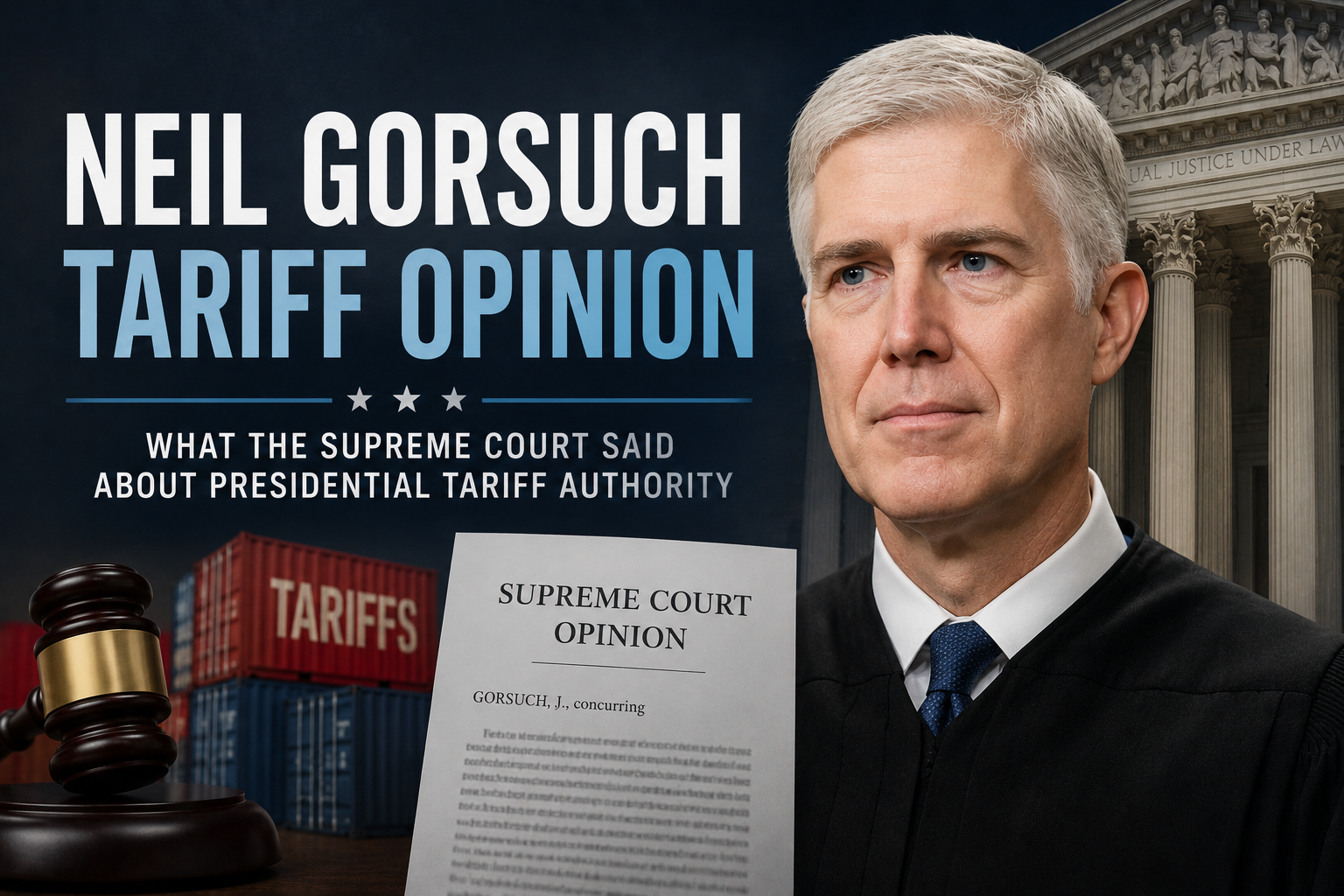
The neil gorsuch tariff opinion was a concurrence, not the Court’s main opinion. Chief Justice John Roberts announced the judgment, and Gorsuch wrote separately to explain why a President claiming an extraordinary delegated power must identify clear language from Congress. In his view, the phrase “regulate importation” did not clearly authorize the far-reaching tariff program challenged in the case.
That distinction matters. Gorsuch did not say that presidents can never impose tariffs. He said Congress must clearly authorize an extraordinary tariff program, especially when the claimed power has no meaningful limit on countries, products, rates, duration, or the emergencies that could trigger it.
What the Supreme Court Decided
The consolidated cases challenged tariffs imposed under IEEPA, a 1977 emergency-powers law normally associated with sanctions, blocked transactions, and controls on foreign property. The administration argued that the power to regulate importation included the power to impose duties on imported goods. The challengers answered that tariffs are taxes and that Congress never placed that revenue-raising power in IEEPA.
Six justices rejected the administration’s reading. Roberts, Sonia Sotomayor, Elena Kagan, Gorsuch, Amy Coney Barrett, and Ketanji Brown Jackson agreed that IEEPA does not authorize tariffs. Clarence Thomas, Samuel Alito, and Brett Kavanaugh dissented.
The official Supreme Court opinion and Gorsuch concurrence show a split in reasoning. Six justices supported the statutory result, but only Roberts, Gorsuch, and Barrett joined the principal opinion’s specific major questions section. Gorsuch’s concurrence is therefore influential analysis, not a separate six-justice holding.
| Part of the case | Court action | Practical meaning |
| IEEPA authority | Rejected | The emergency statute does not itself authorize tariffs |
| V.O.S. Selections | Federal Circuit affirmed | The merits judgment against the tariffs remained in place |
| Learning Resources | Vacated and remanded for dismissal | The district court lacked jurisdiction because the claim belonged in the Court of International Trade |
What Justice Gorsuch Said
Gorsuch began with separation of powers. The Constitution places federal legislative power in Congress, while the executive branch carries out laws Congress enacts. When executive officials claim that an old statute gives them a new power with enormous economic and political consequences, he believes courts should require a clear statement before accepting that claim.
He presented the major questions doctrine as pro-Congress rather than anti-agency. In his account, executive officials act as agents of Congress when exercising delegated legislative authority. An agent may handle ordinary details under general instructions, but should not infer an extraordinary power from loose wording.
| Gorsuch’s point | Plain-English meaning | Application to the tariffs |
| Clear authority is required | Major power needs more specific support than routine administration. | IEEPA never mentions tariffs, duties, taxes, or a similar monetary charge. |
| Past practice matters | A long-unused interpretation is suspicious when it suddenly produces immense authority. | No earlier President used IEEPA itself to impose tariffs during its first half-century. |
| The rule protects Congress | Courts should not let executive interpretation permanently shift legislative power. | The President could not turn a general emergency law into open-ended tariff authority. |
| Foreign affairs is not automatic | Judicial skepticism may weaken when the President has an independent Article II power. | The government conceded that peacetime tariff authority came from Congress alone. |
Why the Statutory Words Were Not Enough
The government relied on the words regulate and importation. Gorsuch accepted that regulate is broad, but thought that breadth made the claimed power less clear, not more. Congress regularly uses specific words when it delegates tariff authority and often adds limits involving rate, duration, products, findings, or procedures.
The official text of 50 U.S.C. Section 1702 lists powers to investigate, block, regulate, compel, nullify, prevent, and prohibit certain transactions involving foreign property. It does not mention tariffs or duties. Gorsuch argued that Congress did not hide a sweeping taxing power inside that general list.
He also rejected the claim that the Court demanded one magic word. In his view, Congress could have used tariff, duty, tax on imported goods, monetary exaction on imports, or another phrase that clearly communicated the same authority. The problem was not vocabulary. It was the absence of a clear transfer of power.
Why Foreign Affairs Did Not Change the Result
The dissents emphasized the President’s traditional flexibility in foreign affairs and trade. Gorsuch accepted that some statutes interact with independent presidential powers, such as the commander-in-chief authority. In those overlapping-power cases, the major questions doctrine may apply with less force.
This case was different because the administration conceded that the President has no independent constitutional power to impose peacetime tariffs. The authority had to come from Congress. Calling tariffs a foreign-policy tool could not reduce the clarity required when the Constitution assigns duties and imposts to the legislative branch.
Gorsuch, Barrett, Kagan, and the Dissents
| Opinion group | Position | Main difference |
| Roberts, Gorsuch, Barrett | IEEPA fails under text and major questions principles. | Required clear congressional authorization for the extraordinary claim. |
| Kagan, Sotomayor, Jackson | IEEPA does not authorize tariffs. | Ordinary statutory interpretation was enough without major questions doctrine. |
| Barrett separately | Agreed with the outcome. | Viewed major questions more as contextual textualism than Gorsuch’s stronger clear-statement rule. |
| Thomas, Kavanaugh, Alito | Would have upheld the tariffs. | Read regulate importation to include tariffs based on text, history, and foreign-trade practice. |
Why the Concurrence Matters
Gorsuch used the case to defend a durable rule for presidents of either party. He noted that executive officials have incentives to expand their authority and that Congress may have difficulty recovering power once a court reads a broad statute to grant it. His warning was institutional, not personal.
He also connected the doctrine to the Supreme Court’s abandonment of Chevron deference. Chevron had sometimes placed a thumb on the scale for agency interpretations of unclear statutes. Gorsuch argued that, with Chevron gone, demanding clarity for extraordinary delegated powers is a return to older legal principles rather than a recent invention.
The concurrence is not itself binding as a majority opinion. Its importance is that it offers future litigants a detailed historical and constitutional framework for challenging large executive programs built on broad, old, or indirect statutory language.
What the Decision Does and Does Not Do
- It holds that IEEPA is not a lawful source of presidential tariff authority.
- It does not eliminate tariffs imposed under other statutes that expressly address duties or import adjustments.
- It does not prevent Congress from passing a new tariff law with clear standards and procedures.
- It does not make every page of Gorsuch’s concurrence a six-justice holding.
- It does not create one automatic refund procedure for every importer that paid an IEEPA tariff.
Frequently Asked Questions
Did Justice Gorsuch write the majority opinion?
No. Chief Justice Roberts wrote the principal opinion. Gorsuch joined it in full and added a separate concurrence.
Was the tariff ruling 6-3?
Yes. Six justices agreed that IEEPA did not authorize the tariffs, although they did not all use the same reasoning.
Did the Court hold all presidential tariffs unconstitutional?
No. The decision addressed tariffs imposed under IEEPA. Other federal trade statutes were not resolved by this holding.
Why was the Learning Resources case dismissed?
That challenge began in federal district court, but this type of tariff claim belonged in the specialized Court of International Trade. The companion V.O.S. case supplied the proper route for deciding the merits.
Can Congress authorize similar tariffs later?
Congress can enact clearer legislation, subject to constitutional limits and any delegation rules that apply.
Bottom Line
Gorsuch’s tariff concurrence is best understood as a warning about institutional power, not a policy judgment about whether tariffs are economically wise. Congress may authorize tariffs, and presidents may administer them within the limits Congress sets. What the executive cannot do, in his view, is convert an emergency law with general wording into an unlimited peacetime tariff code.
For future presidents of either party, the lesson is the same: the larger and more consequential the claimed power, the clearer the statutory authorization must be. That principle, more than the fate of any one tariff schedule, is the lasting point of the concurrence.
| Legal disclaimer
This article provides general legal information for a U.S. audience and does not constitute legal advice. Businesses seeking refunds, challenging duties, or evaluating customs deadlines should consult qualified trade counsel about their specific entries and procedural rights. |
